Understanding Bitrate Ladders in Adaptive Streaming (2026 Complete Guide)

Bitrate Ladders Explained: Adaptive Streaming Guide
Adaptive streaming has become the standard method for delivering video over the internet. Whether viewers are watching a live sports event, a movie on a streaming platform, or a product demo on a business website, they expect smooth playback with minimal buffering and optimal quality.
At the core of adaptive streaming lies a crucial concept: the bitrate ladder.
A well-designed bitrate ladder determines how efficiently video content adapts to varying network conditions, devices, and screen resolutions. Poor ladder design can cause buffering, wasted bandwidth, or suboptimal visual quality. A properly optimized ladder, however, significantly enhances user experience and delivery efficiency.
In this comprehensive guide, we will explore:
- What a bitrate ladder is
- How it works in adaptive streaming
- Why it matters for user experience
- How bitrate ladders are structured
- Best practices for ladder design
- Differences between static and dynamic ladders
- Codec considerations
- Cost and CDN implications
- Future trends in ladder optimization
What Is a Bitrate Ladder?

A bitrate ladder is a predefined set of video encodings at different resolutions and bitrates used in adaptive streaming.
Instead of delivering one single version of a video, adaptive streaming systems encode the same content into multiple variants. These variants are organized into a “ladder” from lowest to highest quality.
For example, a typical ladder might include:
- 240p at 400 kbps
- 360p at 800 kbps
- 480p at 1.2 Mbps
- 720p at 2.5 Mbps
- 1080p at 5 Mbps
- 4K at 12 Mbps
Each step in the ladder represents a tradeoff between quality and bandwidth usage.
The video player dynamically selects the most appropriate step depending on:
- Network speed
- Device capability
- Buffer health
- Screen resolution
Why Bitrate Ladders Are Essential for Adaptive Streaming?
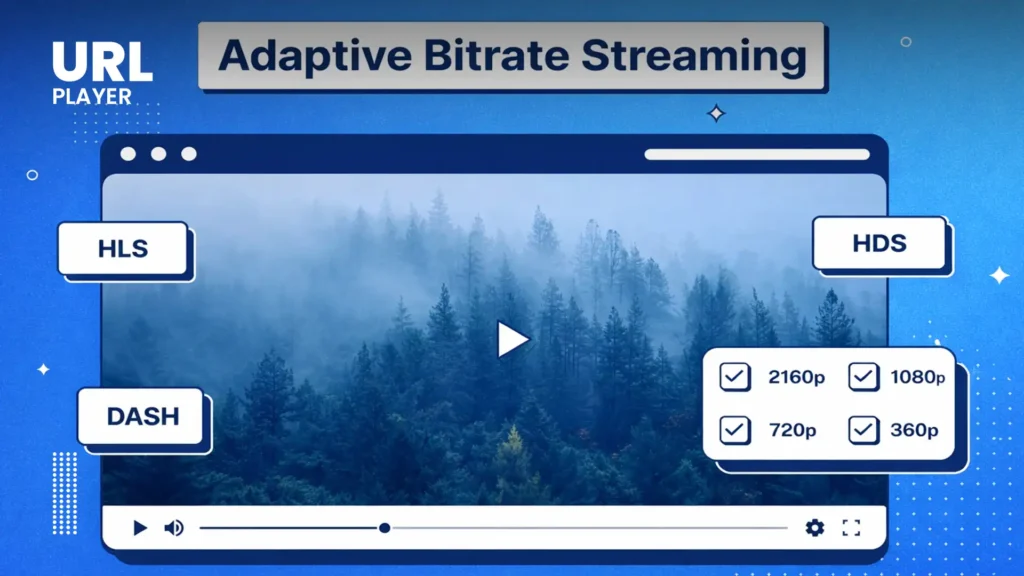
Adaptive streaming protocols such as:
- HLS (HTTP Live Streaming)
- MPEG-DASH
Depend entirely on bitrate ladders.
Without multiple encodings:
- The player cannot switch quality
- Buffering increases
- Playback becomes unstable
The bitrate ladder is what enables Adaptive Bitrate Streaming (ABR).
How Bitrate Ladders Work in Practice?
Let’s break down the process.
Step 1: Multi-Resolution Encoding
The source video is encoded multiple times at different:
- Resolutions
- Bitrates
- Sometimes different codecs
Each version is segmented into small chunks (typically 2–6 seconds).
Step 2: Manifest File Creation
The streaming system generates a manifest file:
- .m3u8 for HLS
- .mpd for DASH
The manifest lists all available bitrate options.
Step 3: Player Selection
When playback begins:
- The player estimates available bandwidth
- Selects an initial bitrate
- Monitors network conditions continuously
If bandwidth decreases, the player steps down the ladder.
If bandwidth improves, the player climbs up the ladder.
This switching is seamless between segments.
Components of a Well-Designed Bitrate Ladder
A bitrate ladder includes more than just resolution changes.
Key components include:
Resolution Scaling
Common resolution steps:
- 240p
- 360p
- 480p
- 720p
- 1080p
- 1440p
- 4K
The ladder must align resolution with realistic device screen sizes.
Bitrate Allocation
Each resolution has an associated bitrate.
Too low → poor visual quality
Too high → wasted bandwidth
Proper allocation balances clarity and efficiency.
Segment Duration
Shorter segments:
- Improve switching speed
- Reduce buffering
Longer segments:
- Reduce overhead
- Increase efficiency
Most platforms use 2–6 second segments.
Codec Efficiency
Different codecs affect ladder structure.
For example:
- H.264 requires higher bitrates
- HEVC (H.265) reduces bitrate needs
- AV1 improves compression further
Codec choice directly impacts ladder design.
How Bitrate Ladders Improve User Experience?

Bitrate ladders improve UX in several measurable ways.
Reduced Buffering
If bandwidth drops:
- The player switches to a lower rung
- Playback continues smoothly
Users prefer lower resolution over buffering interruptions.
Faster Startup Time
Players typically start at a mid-range bitrate.
This ensures:
- Faster playback start
- Quick initial buffering
Startup time heavily influences viewer retention.
Consistent Playback Across Devices
A mobile phone does not need 4K video.
Bitrate ladders ensure:
- Devices receive appropriate quality
- Data usage is optimized
- Performance is balanced
Improved Global Accessibility
Viewers worldwide have different connection speeds.
Bitrate ladders allow:
- Reliable playback in low-bandwidth regions
- High-quality streaming in fiber-connected areas
Static vs Per-Title Bitrate Ladders
Traditional streaming used fixed ladders for all content.
However, modern streaming often uses Per-Title Encoding.
Static Ladder
Same bitrate ladder applied to every video.
Advantages:
- Simpler setup
- Predictable storage requirements
Disadvantages:
- Inefficient for simple or complex content
- May waste bandwidth
Per-Title Encoding
Each video is analyzed individually.
Simple scenes require:
- Lower bitrates
High-motion scenes require:
- Higher bitrates
This optimizes both quality and cost.
Bandwidth and Cost Considerations
Bitrate ladders impact:
- Storage costs
- CDN delivery costs
- Bandwidth usage
More ladder steps mean:
- More storage
- More encoding time
- More CDN traffic
However, poorly optimized ladders increase:
- Buffering
- User abandonment
- Support requests
Balancing cost and performance is critical.
Bitrate Ladders and CDN Performance
Content Delivery Networks (CDNs) distribute video segments globally.
A well-optimized ladder:
- Reduces unnecessary data transfer
- Improves caching efficiency
- Minimizes origin server load
CDN costs scale with bandwidth, so ladder optimization directly impacts expenses.
Designing an Optimal Bitrate Ladder
Best practices include:
Avoid Too Many Steps
Excessive ladder rungs increase complexity without noticeable benefit.
Ensure Logical Bitrate Spacing
Each step should represent meaningful quality improvement.
Optimize for Mobile-First Audiences
Many viewers use mobile networks.
Include low-bitrate options for unstable connections.
Use Efficient Codecs
AV1 and HEVC reduce bitrate requirements significantly.
Test Under Real Conditions
Simulate:
- Slow 3G
- 4G fluctuations
- High-speed broadband
Testing ensures ladder reliability.
Common Bitrate Ladder Mistakes
Avoid:
- Skipping low-bitrate versions
- Over-encoding high-resolution variants
- Using identical bitrates for multiple resolutions
- Ignoring device screen limitations
- Failing to optimize per content type
These mistakes increase costs and harm UX.
Bitrate Ladders and Live Streaming
Live streaming adds complexity.
Ladders must consider:
- Low latency
- Real-time encoding
- CPU limitations
- Viewer network variability
Live ladders often use fewer steps to reduce latency.
Future of Bitrate Ladder Optimization (2026 & Beyond)
Emerging trends include:
- AI-driven ladder generation
- Real-time bitrate prediction
- Dynamic ladder adjustments
- Network-aware streaming
- Viewer behavior-based optimization
Streaming platforms increasingly rely on data-driven ladder design.
Bitrate Ladders vs Fixed Quality Streaming
Fixed Quality:
- One resolution
- Higher buffering risk
- Inefficient bandwidth use
Adaptive Ladder:
- Multiple resolutions
- Dynamic switching
- Better global reach
- Optimized device compatibility
Adaptive streaming is now the industry standard.
Conclusion
Bitrate ladders are the foundation of adaptive streaming performance. They determine how efficiently video content adapts to varying network conditions and device capabilities.
A well-designed ladder reduces buffering, improves startup time, lowers bandwidth waste, and enhances overall viewer satisfaction. Poor ladder design, on the other hand, can increase costs and damage user experience.
As streaming technology evolves, bitrate ladder optimization remains a critical factor in delivering scalable, high-quality video experiences across the modern web.
For businesses, content creators, and streaming platforms, understanding bitrate ladders is essential for balancing quality, performance, and cost in 2026 and beyond.